
Just Hail Mary / Decision Guide 04 / Launching soon
Care technology
equipment map.
Start with the care need. Build a category shortlist. Resolve the product and commercial route with evidence.
Research Edition 0.1 / August 2026 / 14 minute read
- 01Need
- 02Context
- 03Category
- 04Route
Use this map if you are
- At homeTrying to solve a temporary or lasting care need
- Providing careComparing equipment families before procurement
- Coordinating a groupPlanning a supported portfolio across sites
- Exploring the horizonSeparating established equipment from emerging robotics
Category decision helper / Deterministic
Find the equipment families worth investigating.
Seven non-sensitive choices are scored against the public 45-class research register. Nothing is stored or sent.
Loading research register
The 45 care technology classes are being prepared.
Commercial routes to examine
Deployment requirements
01 / Decision boundary
A shortlist is the start of diligence.
The matrix makes the first conversation more precise without pretending that a form can complete an assessment.
It can
- Map a care outcome to equipment classes
- Separate established, emerging and horizon categories
- Surface likely commercial routes
- Expose the main deployment gate
It cannot
- Recommend a manufacturer or model
- Diagnose a person or replace assessment
- Confirm stock, price or service coverage
- Approve or offer finance
For a practical need-first workflow, begin with Where Do I Start? and bring the resulting brief into this map.
02 / Equipment families
Care technology is wider than any one catalogue.
The research register starts with everyday care equipment and extends carefully toward assistive robotics.
Alarms and wearables
Pendants, care-specific wrist devices, fall detection, location and response.
Sensors and monitoring
Occupancy, movement, doors, environment, falls and defined escalation.
Medication support
Reminders, dispensers and governed administration hardware.
Beds and pressure care
Profiling beds, specialist mattresses and individually assessed surfaces.
Moving and mobility
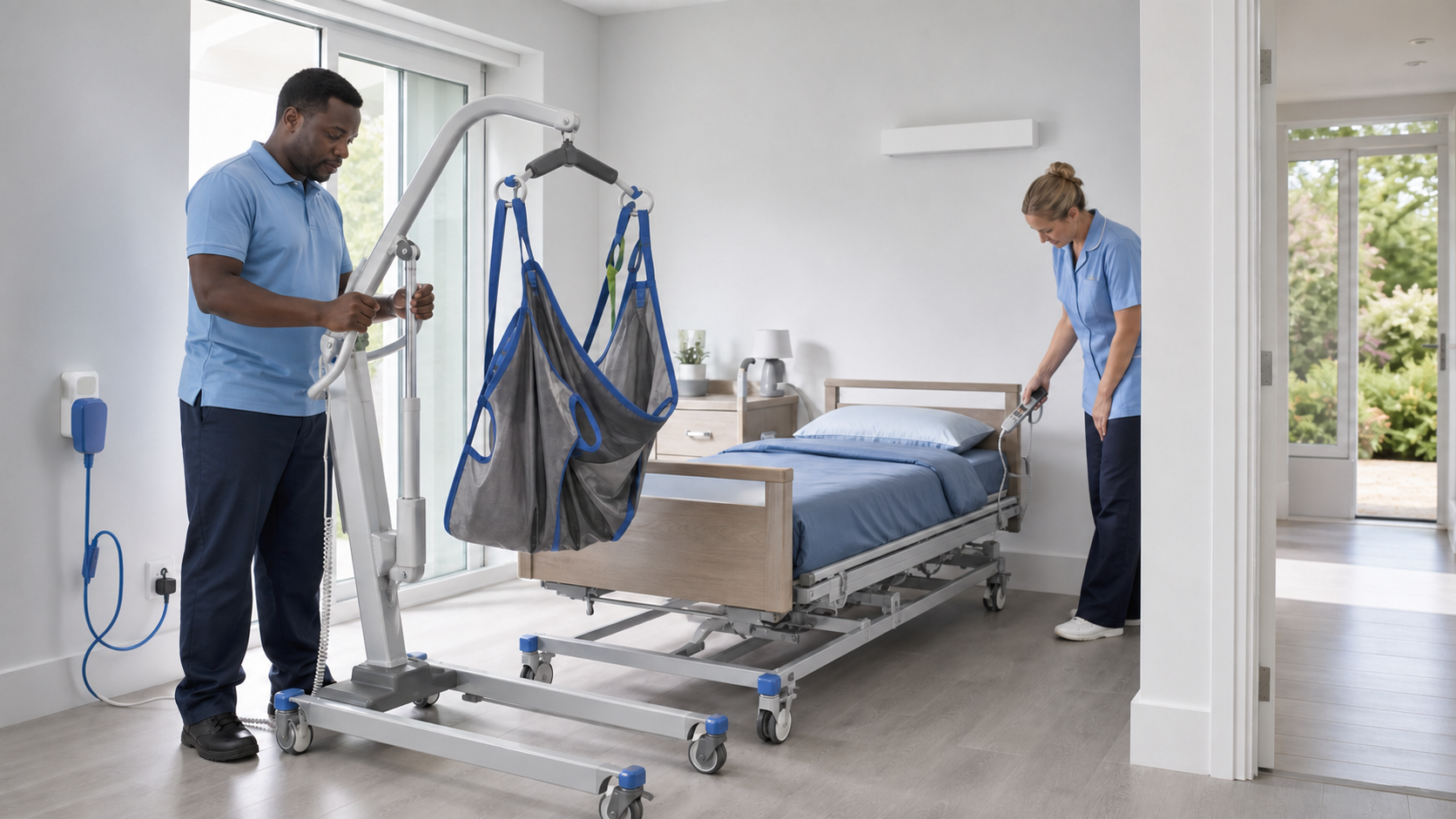
Hoists, transfer aids, chairs, wheelchairs and specialist bathroom equipment.
Connected environments
Communication, accessible controls, alerting and care-operation systems.
Care robotics
Companionship, cleaning, internal delivery and telepresence for bounded tasks.
Humanoid horizon
A north-star research category, not a current product or availability promise.
Explore the care technology landscape for a fuller explanation of the category boundaries.
03 / Commercial routes
The route follows the useful period and service burden.
No class is permanently attached to one route. Assessment, product economics and supplier terms still matter.
The complete service boundary is explained in From Equipment to Infrastructure.
04 / Short-term access
Expensive is not the same as leasable.
A short lease works when temporary value and repeatable redeployment outweigh delivery, service and recovery cost.
Temporary need
Is the equipment needed for recovery, reablement, bridging, respite or a bounded trial?
Repeatable asset
Can the core asset survive multiple deployments with known parts and service?
Safe redeployment
Can it be collected, inspected, cleaned, documented and matched again?
Viable logistics
Do delivery, installation, collection and support remain economic?
Profiling beds, dynamic mattresses, mobile hoists, specialist chairs and powered mobility are the leading short-term candidates in the research register. A pendant or low-cost sensor may fit a managed service better because monitoring and response carry much of the value.
05 / Context and support
The same device can create very different obligations.
Standalone, connected and governed equipment should not be treated as interchangeable.
Standalone and connected
- Standalone. The equipment can perform its core function without monitoring or integration. Ownership, inspection and safe use still need to be clear.
- Connected. The outcome depends on connectivity, an account, software, a hub or a monitoring service.
Governed and lifecycle
- Governed. The device sits inside a care plan, staffed response, regulated process or multi-site service. Evidence and exception ownership matter.
- Lifecycle. Installation, training, maintenance, incident handling, replacement and exit are part of the decision.
Hail Mary OS is intended to keep those commercial and operational states connected. See what the operating layer manages.
06 / Research register
Explore all 45 equipment classes.
Filter the launch research, expansion range and humanoid horizon. Category presence does not mean availability.
The complete 45-class register is available in the interactive web edition and as the machine-readable JSON source. It includes source references, maturity gates, settings, outcomes, support profiles and commercial-route hypotheses.
07 / Evidence and safety
Category fit does not prove product suitability.
Every product still needs intended-purpose, regulatory, assessment, service and operating diligence.
08 / Current boundary
Research first. Availability later.
Just Hail Mary is launching soon. The public map makes the intended range legible without turning research into an offer.
Present now
- Forty-five category-level research records
- Published source references
- Deterministic shortlist rules
- Explicit commercial hypotheses
Not claimed
- Current stock or nationwide coverage
- Manufacturer relationships
- Product suitability or clinical advice
- Pricing, finance terms or approval
Portable edition
Take the equipment map into the assessment conversation.
Use the A4 edition for category boundaries, commercial routes and supplier diligence.
Bring the need, not a product name
Turn a category shortlist into an assessable requirement.
Just Hail Mary can help resolve the equipment, commercial route and support boundary.
Guide record
- Edition
- Research Edition 0.1
- Updated
- 4 August 2026
- Register
- 45 equipment classes
- Decision mode
- Deterministic category shortlist
- Source format
- JSON register
- Contact
- enquiries@panamorphix.com
This guide is educational material and not legal, regulatory, clinical, safety, procurement or financial advice. Requirements and obligations must be assessed for the equipment, intended use, person, setting and jurisdiction.