Just Hail Mary / Foundation Guide 01 / Launching soon
From equipment
to infrastructure.
Buying or leasing care equipment is a transaction. Making it dependable requires a complete service model.
Care Foundation Edition 0.2 / August 2026 / 18 minute read
- 01Source
- 02Finance
- 03Deploy
- 04Manage
Read this if you are
- OperatingAssessing a real workflow or site
- FinancingComparing purchase, lease and service
- SupplyingBuilding a route from OEM to operator
- EvaluatingCovering the category, company or market
01 / Opening argument
The equipment is not the service.
Manufacturers build capable care technology. People and care providers need dependable support in ordinary life.
A product may arrive with impressive capability and still leave the hardest questions unanswered. Is it right for the person and setting? Who assesses and prepares the environment? How is access financed? Who installs, trains and responds when performance changes? Where do incidents, maintenance, return and replacement decisions live?
Those questions are not secondary administration around the technology. Together they form the commercial and operational system that determines whether the asset can become dependable infrastructure.
Care technology has two lives. The first is the visible product: sensing, alerting, supporting, lifting, moving or assisting. The second is the service around it: selection, contracting, installation, monitoring, maintenance, return and replacement. The first creates capability. The second makes it dependable.
The equipment arrives once. The service model has to arrive every day.
This guide is about that second life. It is written for households and care providers that need technology without pretending purchase is the end of the decision, and for manufacturers and partners that need a clearer route into responsible care use.
 Asset
Asset
03 / Category definition
Care technology as managed infrastructure.
A model for giving households and care providers access to technology together with the finance, installation, support and lifecycle accountability required to depend on it.
The model begins where a one-off equipment transaction ends. It treats the product as an asset inside a continuing service, not as a self-contained object that becomes the customer's problem at delivery.
Three commercial forms can look similar while carrying very different responsibilities:
Care Technology as a Service does not imply that every supplier or responsibility becomes one legal entity. It means the customer has one visible model for how the parts work together. Contracts may remain separate. Operational accountability cannot disappear between them.
The product is not only access to equipment. It is access to a managed operating model.
04 / Just Hail Mary
Source. Finance. Deploy. Manage.
Four connected responsibilities turn care equipment from an isolated asset into a managed service.
-
01
Source
Qualify the outcome, task, site, supplier and asset fit before commercial structure hardens around the wrong machine.
-
02
Finance
Structure access and term while making capital, utilisation, support and residual-value assumptions visible.
-
03
Deploy
Coordinate customer, site, supplier, commissioning, acceptance, support and fallback across the service boundary.
-
04
Manage
Preserve the operating record through maintenance, incidents, changes, upgrades, replacement, redeployment and exit.
The value is in the continuity between these stages. Asset selection shapes the finance structure. Finance assumptions depend on operating hours, service life and replacement. Deployment establishes the records and responsibilities management will need later. Lifecycle evidence should influence the next asset decision.
Just Hail Mary is building this commercial and service layer around care technology. The aim is one accountable model from first qualification through return or replacement, while preserving the specialist role of manufacturers, assessors, finance providers and support partners.
05 / Source
Select for the operation, not the demonstration.
Vendor-agnostic selection starts with accepted work and operating conditions, not a manufacturer's catalogue.
A useful selection brief describes the outcome before the asset. It identifies what the operation will accept, where the task happens, when it must happen, which variations are ordinary and what consequence follows from delay or interruption.
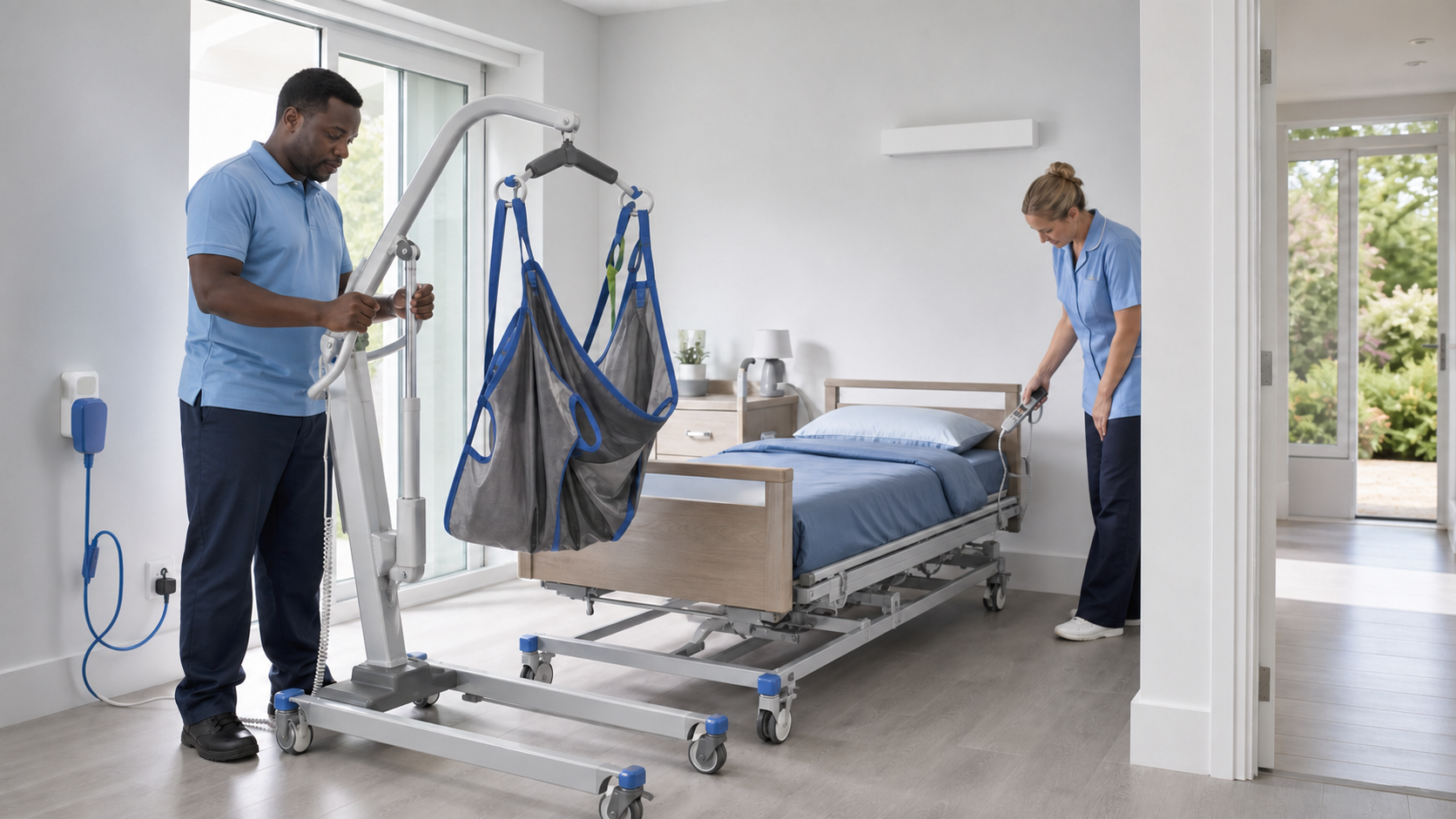
Care technology assets are not interchangeable. A sensor, bed, hoist or mobile platform can differ in fit, runtime, charging, sensing, maintainability, support coverage, data behaviour, environmental limits and integration boundary. Those differences only become meaningful against a named care need and setting.
A selection brief should name
- Outcome: the completed work the operation can accept and use.
- Task and site: space, surfaces, objects, traffic, people, access and environmental variation.
- Operating window: hours, demand pattern, charging opportunity and support requirement.
- Human roles: preparation, supervision, recovery, maintenance and right to stop.
- Technical dependencies: power, connectivity, integration, data and cybersecurity boundaries.
- Lifecycle: service, spares, changes, upgrades, replacement, return and exit.
Vendor-agnostic does not mean universal compatibility or a promise that a suitable asset exists. It means the operating need remains the authority. The purpose is to compare available asset families and suppliers against the same bounded requirement, record the gaps honestly and reject a deployment where the fit is not credible.
Start with the work the organisation must accept, then choose the machine that can enter that work.
06 / Finance
Finance the useful lifecycle.
The lowest headline asset price is not necessarily the lowest cost of dependable operation.
Purchase, lease and managed-service structures distribute capital, technology, support and residual-value risk differently. Ownership can make sense where the asset, utilisation, service life and internal operating capability are well understood. Leasing infrastructure can align cost with a defined term. A managed service can make deployment and lifecycle responsibilities more visible. None is automatically correct.
The finance decision should use the same operating assumptions as the deployment decision. A business case built from theoretical capacity will not survive if the site, support window, supervision burden or downtime pattern produces far fewer accepted outcomes.
Make the whole numerator visible
- Asset purchase, lease or service charge.
- Integration and site preparation.
- Connectivity, software and data services.
- Support, maintenance and spares.
- Supervision, recovery and operational administration.
- Downtime, contingency and fallback.
- Insurance where applicable.
- Upgrade, replacement, return and exit.
The strongest commercial structure does not hide uncertainty. It names the assumptions with the greatest power to break the case: utilisation, accepted-task rate, support response, service life, residual value, demand stability or dependence on specialist intervention.
Just Hail Mary does not use this framework to promise savings. It uses it to create a more honest comparison between ways of accessing and supporting care technology.
07 / Deploy
Deploy the service boundary.
A deployment can fail between individually competent parties. The interfaces need ownership before go-live.
The manufacturer supplies the machine. A finance provider structures access. The customer prepares the site. Internal technology teams manage systems and connectivity. Operations supplies people and fallback. Support handles faults. Each participant can fulfil a narrow obligation while the end-to-end service remains unowned.
Deployment should therefore produce more than an installed asset. It should establish a shared operating boundary with a named outcome, conditions, responsibilities, acceptance method, evidence access and escalation path.
The deployment record should establish
- The accepted outcome and deployment envelope.
- Site, power, connectivity, access and integration dependencies.
- Commissioning tests and operational acceptance.
- Who may start, stop, reset, escalate and approve change.
- Support windows, response paths, spares and fallback.
- Incident, maintenance and performance evidence access.
- Software and hardware change control.
- Upgrade, replacement, redeployment and exit conditions.
Contracts may remain separate. Operational accountability cannot disappear between them.
08 / Manage
Manage the lifecycle, not only uptime.
An asset can remain physically present while becoming commercially or operationally obsolete.
Go-live is the beginning of the operating record. The organisation now needs to understand where the asset is, which contract and site it belongs to, its service state, maintenance history, incidents, changes, support obligations and replacement path.
Uptime remains important, but it is not the whole lifecycle. A machine may technically run while producing less accepted work, requiring more recovery, depending on unavailable expertise or approaching a support boundary. A contract may continue while the operation, demand or asset fit has changed. Management must connect the physical, commercial and operational record.
Lifecycle decisions need evidence
- Maintain: performance and support remain credible inside the current requirement.
- Change: a site, process, hardware or software change needs new acceptance and ownership.
- Upgrade: a newer component or service can improve the operating case without losing continuity.
- Redeploy: the asset may fit another task or site better than the current one.
- Replace: supportability, performance, economics or risk no longer justify the current asset.
- Exit: the organisation needs a controlled return, data, contractual and operational close.
A mature service does not treat replacement as failure. Replaceability is a feature of infrastructure. The machine should be able to change without losing the customer, contract, deployment, maintenance and evidence history around the service.
09 / Hail Mary OS
The commercial and service record behind financed care technology.
The software boundary follows the asset lifecycle. It does not operate the autonomy stack.
Hail Mary OS is being built to preserve the commercial and operational record required to manage purchased, leased and financed care technology consistently. Publicly described areas include customers, contracts, assets, deployments, invoices, payments, incidents, maintenance and commercial performance where supported by implementation.
The boundary is explicit. Hail Mary OS does not control medical devices, sensors, beds or robots, make clinical decisions, plan missions or replace manufacturer safety systems. Its job is the commercial and asset-lifecycle record around those products.
Octeryx OS Care is a separate Panamorphix sister venture in active R&D. It is being designed to preserve governed identity, continuity, consent, policy, provenance and evidence across people, systems, devices and robots. It is not a bundled or live JHM service, does not control equipment and does not make care decisions.
That separation matters. A customer should be able to replace equipment, a supplier or specialist control system without losing the commercial and operational history of the service. Likewise, a manufacturer should not have to become the customer's finance and lifecycle operating system in order to deliver a capable product.
The asset may change. The operating record should survive it.
10 / Economics
Count accepted outcomes, not theoretical capacity.
Machine hours only create value when they produce work the operation can accept and use.
Headline capacity can be a poor denominator. Available hours are not the same as productive hours. Productive motion is not the same as completed work. Completed work is not useful if it misses the required quality, timing, safety or evidence threshold.
A stronger comparison uses accepted useful outcomes inside the real operating window. The numerator includes the whole lifecycle described in this guide. The denominator includes the demand and operating conditions the organisation can genuinely support.
A shared finance and operations worksheet
- What does the existing process cost under the same demand, quality and risk assumptions?
- Which outcomes must be completed, and what makes one acceptable?
- How many operating hours are genuinely available after charging, maintenance and site constraints?
- What supervision, recovery and fallback work remains human?
- Which support response is required by the consequence of interruption?
- How do upgrade, replacement and exit affect the term?
- Which single assumption has the greatest power to invalidate the case?
This method does not guarantee a positive case. That is the point. It makes a weak case easier to stop and a strong case easier to explain.
11 / Portfolio scale
Scale is repeatable lifecycle management.
Adding equipment is not the same as building dependable care infrastructure.
A first asset can survive on expert attention, informal communication and the memory of the people who assembled the service. A multi-site portfolio cannot. Scale requires common records, installation patterns, acceptance, support ownership, maintenance, evidence and replacement decisions across equipment and care settings.
- 01Single asset
Expert-supported learning in a named task and site.
- 02Repeatable deployment
Common preparation, acceptance, recovery and support pattern.
- 03Managed portfolio
Shared asset, contract, maintenance, incident and evidence records.
- 04Cross-site operation
Local variation managed through configuration and named ownership.
- 05Business-critical infrastructure
Continuity, security, audit and lifecycle controls match the consequence of failure.
The scaling question is not simply how many units can be financed. It is which decisions, diagnostics and recovery actions still depend on the original sales, engineering or site team. Any dependency that cannot travel with the service will become a constraint as the fleet grows.
12 / Working tool
Deployment operating model canvas.
Use this before a purchase, lease, pilot or service discussion to expose the first unowned responsibility.
Start with the outcome, then name and evidence ownership across the lifecycle.
Critical-gap question: Which unowned responsibility could stop useful care even if the equipment performs correctly?
This canvas is an operating-model prompt. It is not a safety assessment, procurement recommendation, performance guarantee or certification.
Portable edition
Use the full guide in the room where the decision happens.
Download the A4 edition with the lifecycle frameworks and printable operating model canvas.
13 / Current public boundary
Be precise about what exists today.
A clear category argument does not require an inflated traction or product claim.
Publicly described
- Source, finance, deploy and manage as the intended service model.
- Vendor-agnostic asset selection.
- Deployment and support coordination.
- Asset-lifecycle records.
- Hail Mary OS as the commercial and operational record layer.
Not currently claimed
- Named live customer portfolios or deployment volume.
- Quantified savings, utilisation or performance outcomes.
- Certified safety status or regulatory approval.
- Named financing partners.
- Universal asset compatibility.
- Robot control, route planning or autonomy orchestration.
The practical next step is a bounded care requirement: define the person, outcome, setting, likely duration, product category, finance question, support need and lifecycle owner. That is enough to begin a serious conversation without pretending the final product is already known.
As evidence grows, public claims can grow with it. Until then, the proof boundary protects operators, partners and the credibility of the category.
Start with an operating requirement
Make the equipment replaceable and the care service dependable.
Just Hail Mary is building the commercial and service layer for accessing care technology as managed infrastructure rather than as an isolated purchase.
Company at a glance
- Category
- Care technology access and lifecycle management
- Core role
- Source, sell, lease, finance and support care technology
- Software
- Hail Mary OS, the commercial and operational record layer
- Boundary
- Commercial and asset lifecycle, not robot control
- Canonical site
- justhailmary.com
- Edition
- Care Foundation Edition 0.2 / August 2026
Mark Nicoll - Founder . This guide is educational material, not a safety assessment, engineering specification, procurement recommendation, legal opinion, insurance assessment or financial recommendation.