
Just Hail Mary / Field Guide 02 / Launching soon
Robotics,
wearables
& sensors.
A care-focused map from personal alarms and smart beds to care robots and the humanoid horizon.
Care research edition 0.2 / August 2026 / 16 minute read
- 01Sensors
- 02Wearables
- 03Smart care equipment
- 04Care robots
- 05Humanoid horizon
Read this if you are
- At homeUnderstanding what support may be practical
- Providing careMatching technology to a real care need
- ProcuringChoosing purchase, lease or finance
- ManufacturingSeeking a responsible route into care
01 / Market orientation
Do not begin with the most advanced-looking answer.
The visible market is organised by products. A useful care technology decision begins with the person, the setting, the need and the likely duration.
Care technology appears in many forms: a pendant alarm, a GPS watch, an occupancy sensor, a medication dispenser, a profiling bed, a mobile hoist or a robot that moves supplies. The most useful answer may be the smallest device in the room.
The product class does not dictate the commercial route. A profiling bed needed during recovery may suit a short lease, while the same class of bed may be financed across several years in a care home. A low-cost sensor may still belong in a managed service because its value depends on connectivity, monitoring and human response.
Match the technology and the term to the care need.
This guide names representative manufacturers where that helps orientation. It does not rank suppliers, provide procurement advice, confirm UK availability or imply a relationship between any named manufacturer and Just Hail Mary. Direct leasing competitors are excluded.
02 / Asset map
Five families. One care-first progression.
Begin with established care technology and keep robotics visible as a direction, not as the default answer.
Sensors
Falls, occupancy, movement, environment, location and other events connected to a response.
Care wearables
Purpose-built pendants and watches for alarms, falls, location and care response.
Smart care equipment
Medication support, electric beds, pressure care, hoists, specialist seating and mobility.
Care robots
Bounded cleaning, internal delivery, telepresence and assistive tasks in care environments.
Humanoid horizon
Future mobile manipulation and assistance, held behind evidence, safety and support gates.
Just Hail Mary's intended role sits across these families: source and qualify, choose an appropriate purchase, lease or finance route, then preserve the commercial and operational record through maintenance, return, redeployment and replacement.
03 / Care robotics and horizon
A robot must earn its place in the care environment.
The near-term opportunity is bounded work that supports people and care teams. The humanoid remains a north star, not a current lease promise.
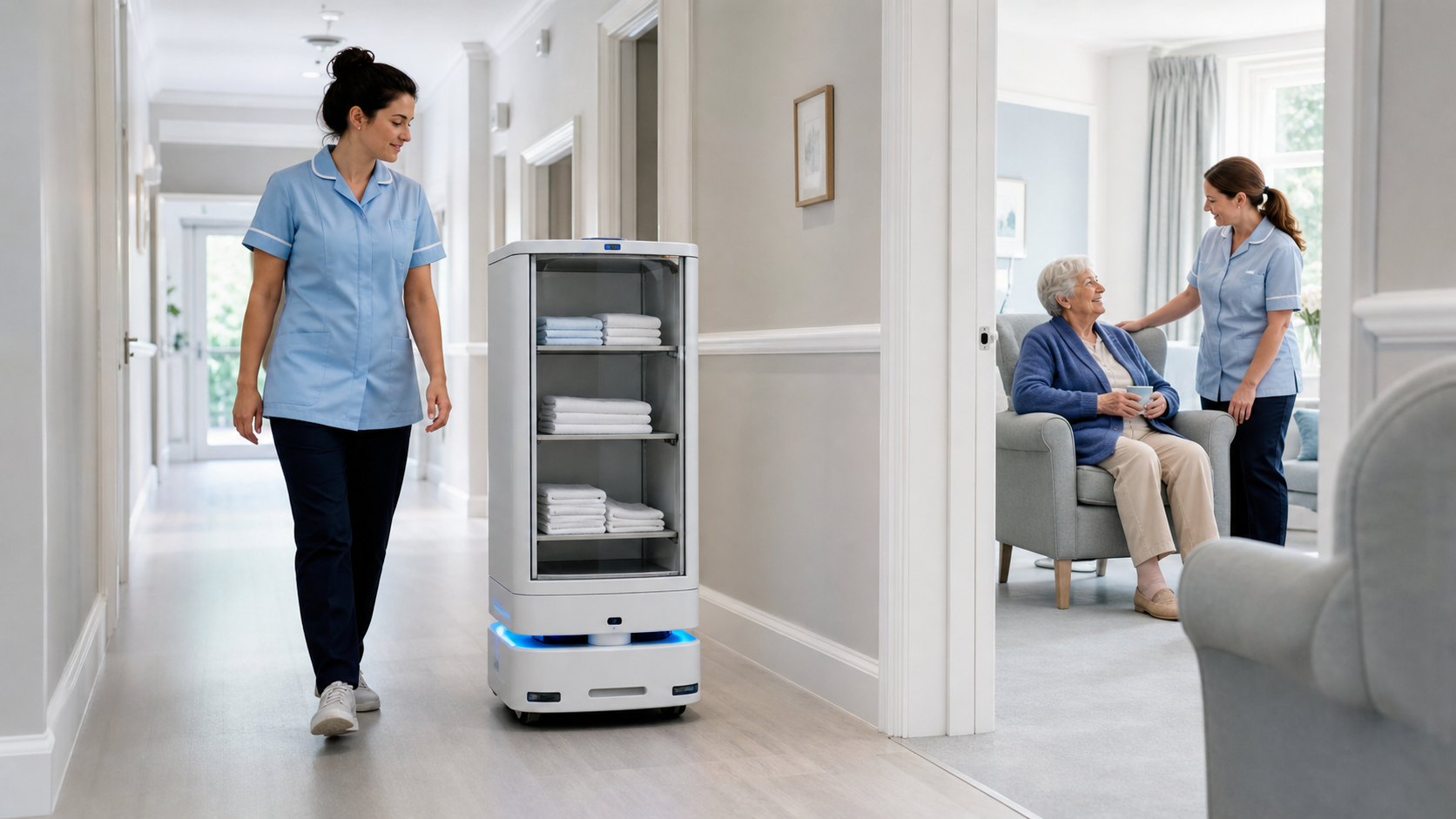
Bounded support inside ordinary care. Workflow, safeguarding, service response and human acceptance matter as much as navigation.
Delivery and supply movement
Moving linen, meals or supplies can return time to care teams when routes, handoffs and fallback are tightly defined.
Floor-care systems
Potentially repeatable work, but infection control, public-space behaviour, mapping and service coverage remain deployment gates.
Remote participation
Useful only when privacy, consent, connectivity and the role of human care are explicit.
Mobile manipulation
Future assistance with bounded non-clinical tasks, held behind independent evidence, regulation, reliability and support readiness.
Finance, maintenance and product safety do not supply the governed resident context needed around a requested action. Octeryx OS Care is researching that separate context boundary through declared capabilities, explicit preconditions, bounded commands, receipts and defined failure states.
Robotics should enter the catalogue through a named care problem, not as spectacle. Any future manufacturer entry must be assessed for UK availability, channel fit and direct leasing conflict before publication.
04 / Care-specific wearables
Begin with devices designed around a care response.
Purpose-built pendants and watches can connect alarms, falls and location to a named response without making consumer smartwatch resale the launch dependency.
A device connected to a response. Comfort, charging, connectivity, monitoring and escalation define whether the wearable is useful.
iVi and Vibby
Care-specific wearable devices for manual alarms and automatic fall detection through a compatible telecare system.
Official iVi informationAmy
A purpose-built GPS alarm watch designed around safety, independence and connection to a care network.
Official Amy informationGO 4G
A mobile GPS personal alarm with optional fall detection for support at home and while out.
Official GO informationCare@Home wearables
Wearable emergency and fall-detection devices designed to work with the Care@Home platform.
Official fall-detection rangeJHM should begin with care-specific wearables. Apple Watch and other consumer brands belong in a later BYOD or authorised-channel layer, after traction and support capability exist. Inclusion above does not confirm a JHM supply relationship or current lease availability.
05 / Sensors and telecare
Sensors can be the smallest assets with the widest boundary.
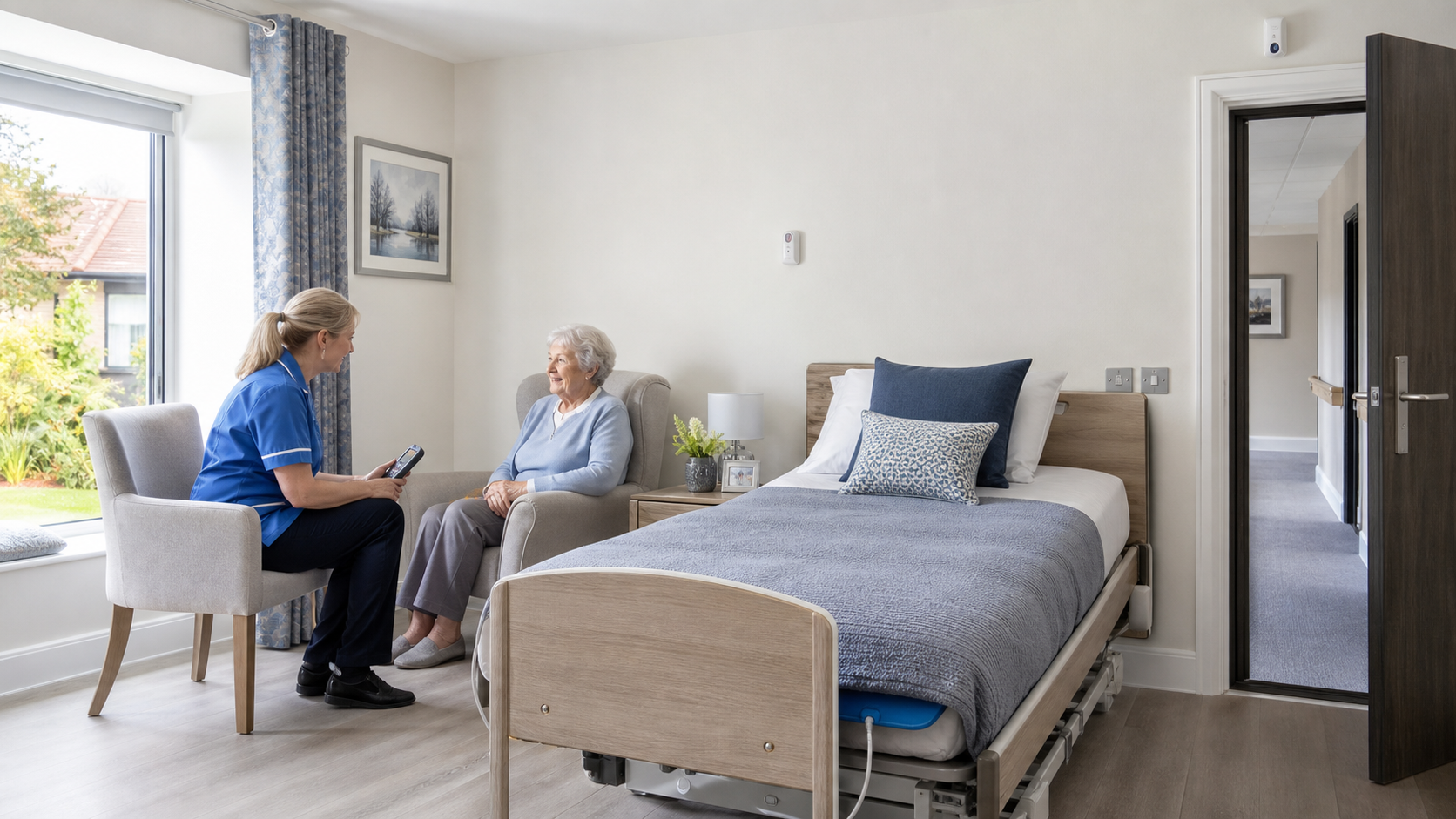
The device may be compact, but its useful life depends on networks, gateways, calibration, software, data governance and response ownership.
A room connected to a human response. Gateways, batteries, calibration, data handling and response ownership define the useful system.
Telecare sensor portfolio
Home hubs, occupancy, movement, environmental, property-exit, epilepsy and medication-support devices connected to a care response.
Official independent-living portfolioMDsense
A non-wearable room sensor designed to detect falls without requiring a pendant to be worn.
Official MDsense informationGPS personal alarms
Care-specific mobile devices that connect location, alarms and caregiver response for support beyond the home.
Official personal-alarm rangeA sensor arrangement is rarely about the device alone. Define which event is detected, where the data travels, who acts, which subscription or gateway is required, how batteries and configuration are managed, and what happens to the data and devices at exit.
06 / Smart care equipment
Most valuable care technology does not need to call itself autonomous.
Electric beds, patient handling and mobility equipment belong in the same lifecycle conversation when they are powered, service-dependent or connected.
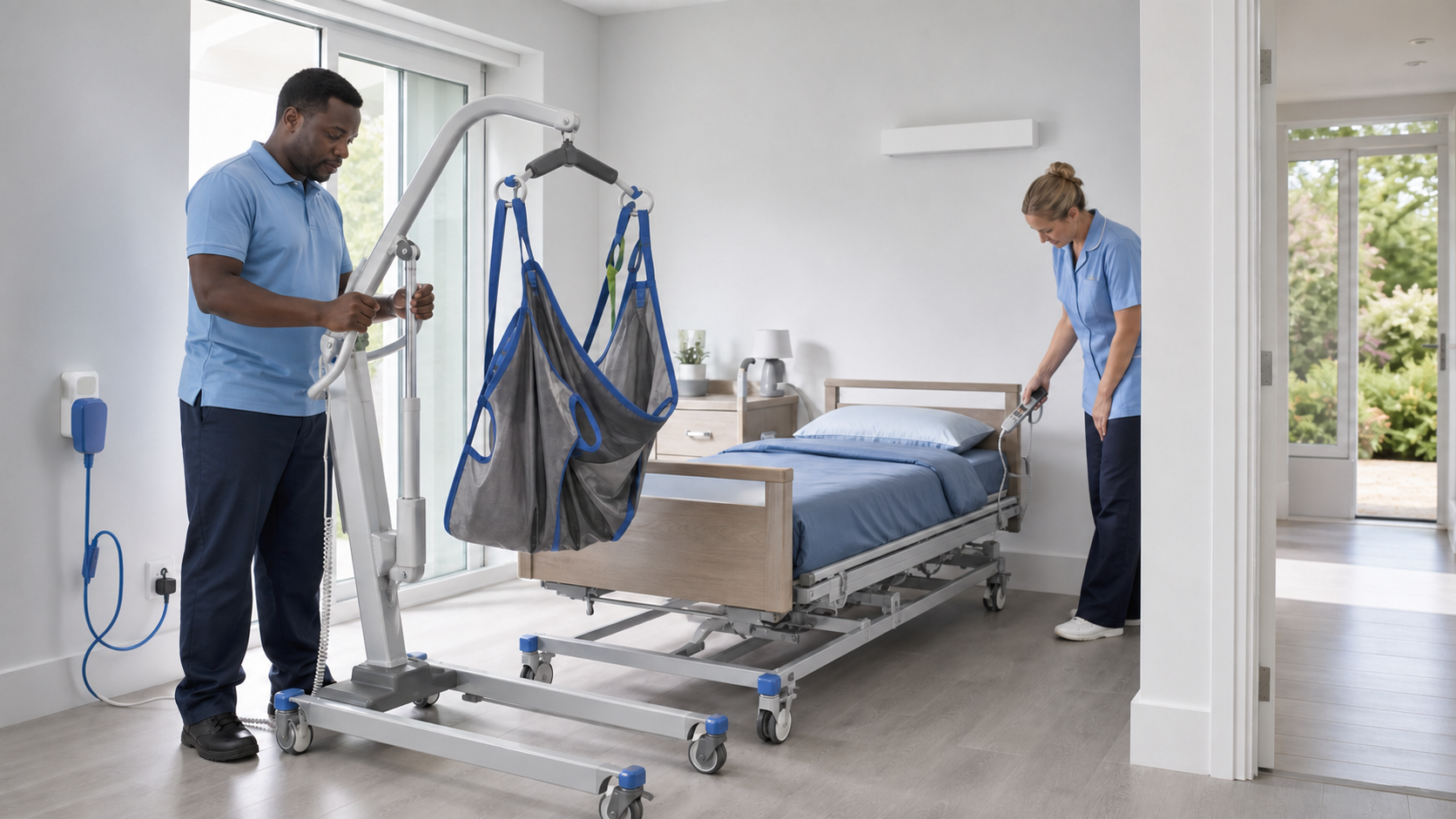
Equipment prepared as one care workflow. Inspection, accessories, charging, service access and replacement belong inside the lifecycle plan.
Healthcare and long-term care beds
Electrically adjustable beds designed across acute, specialist and long-term care settings.
Official Eleganza 1 informationMobile and ceiling hoists
Patient-handling equipment spanning mobile hoists, ceiling systems, sit-to-stand aids and associated service tooling.
Official mobile hoist rangeBed and chair occupancy sensing
Pressure-pad sensing designed to identify unexpected bed or chair activity and raise an alert through a connected care system.
Official occupancy sensor informationThis wider scope is central to a care-focused model. A customer may need a coordinated mix of powered equipment, wearables and sensing, with robotics introduced only where the care case supports it. The commercial layer must preserve who owns, maintains, uses, supports and eventually replaces every asset in that mix.
The same class may support different routes. A profiling bed needed for recovery may suit a lease of weeks or months. A care-home bed fleet may suit longer-term finance. Assessment, servicing, decontamination and return economics decide whether either route is responsible.
07 / Commercial structure
Not every capable product is a financeable service.
A leaseable asset needs a visible useful life, support boundary and exit path around the equipment.
Identifiable asset
Model, configuration, payloads, accessories, software and serialised components are known.
Accepted outcome
The task and service level can be tested in the real operating environment.
Support route
Maintenance, remote support, consumables, response and escalation have named owners.
Useful term
The contract term reflects expected use, technology change and the customer's adoption horizon.
Data boundary
Licences, connectivity, data access, retention and end-of-term handling are explicit.
Exit route
Return, refurbishment, redeployment, upgrade, replacement and disposal are considered before signature.
A lease does not remove technology risk. Leasing infrastructure gives the parties a structure in which that risk can be made visible, allocated and revisited through the asset lifecycle.
08 / Before finance
Compliance follows the intended use, not the marketing category.
The same-looking product can create different obligations depending on whether it is work equipment, lifting equipment, a medical device or a system that monitors people.
Establish before selection
- The intended use and the people affected.
- Whether the equipment is a regulated medical device.
- Applicable workplace, lifting and equipment-safety duties.
- Site, connectivity, infection-control and accessibility constraints.
- Data protection, cyber security and monitoring boundaries.
Preserve through the term
- Conformity, registration and supplier documentation.
- Installation, inspection and training evidence.
- Maintenance, software and configuration history.
- Incident, corrective-action and safety-notice records.
- Return condition and end-of-life evidence.
The UK Health and Safety Executive states that work-equipment duties can apply whether equipment is owned or leased, and specifically identifies bedrails, hoists and electric profiling beds in health and social care. The MHRA maintains separate rules for medical devices placed on the UK market. These are diligence inputs, not a substitute for competent legal, safety, clinical or regulatory advice.
HSE equipment safety in health and social care
MHRA guidance on regulating medical devices in the UK
09 / Research register
Follow the manufacturer, then verify the deployment.
Product ranges, ownership, availability and specifications change. Official links are the starting point for current diligence.
All manufacturer descriptions in this edition are editorial summaries of official public product pages reviewed on 4 August 2026. Inclusion is unpaid and does not imply partnership, endorsement, procurement approval, lease availability or suitability for a particular setting.
Manufacturers may contribute one short, attributed perspective in a later edition. Contributions will be added only after written approval and will remain clearly identified as the manufacturer's own words.
Portable edition
Take the equipment landscape into the sourcing conversation.
Download the A4 edition with representative manufacturers, leasing questions and the public source register.
The next question
Start with the work, not the catalogue.
Turn the outcome, site, people, service boundary and lifecycle into a short operating requirement before asking any manufacturer for a product.
Guide record
- Edition
- Care Research Edition 0.2
- Reviewed
- 4 August 2026
- Scope
- Care technology and equipment landscape
- Excluded
- Leasing competitors and finance providers
- Method
- Official manufacturer and UK authority sources
- Contact
- enquiries@panamorphix.com
Just Hail Mary has no claimed commercial relationship with the manufacturers named in this edition. Specifications and availability must be verified directly. This guide is educational material and not legal, regulatory, clinical, safety, procurement or financial advice.